
Free AI writing checkers are everywhere. Some promise impressive accuracy, require an email address before showing results, or reserve their detailed reports for paying customers. Finding one that's genuinely free and useful takes a little digging, especially when the results could affect how someone judges your writing.
DetectGPT offers a different approach. This browser-based AI content detector provides an estimated AI writing score, highlights individual sentences, and lets users check drafts without creating an account. It also offers a plagiarism checker and rewriting tools.
But how reliable is DetectGPT? Can it distinguish human writing from ChatGPT-generated content, and is it worth adding to your editing routine? This review examines its features, practical benefits, limitations, and the situations where a free AI detector can actually help.
For a broader look at writing assistants and their capabilities, see our guide to AI content creation for articles, blogs, and websites.
The Short Verdict
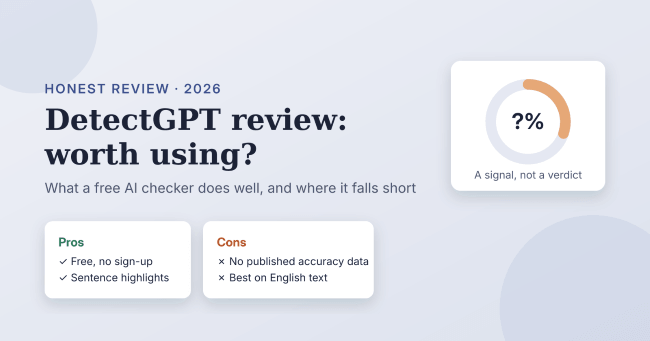
DetectGPT is a practical free AI writing checker for students, bloggers, editors, and anyone who wants a second opinion on a draft before publishing or submitting it. Its biggest advantage is sentence-level highlighting. Rather than leaving you with an unexplained percentage, the tool identifies passages that resemble machine-generated writing.
The checker is easy to access, requires no registration, and supports pasted text or publicly accessible web pages. Those conveniences make it particularly useful for reviewing articles, essays, and other written material without setting up another account.
There are important limitations. DetectGPT doesn't provide independently validated accuracy benchmarks, works best with English text, and cannot establish who actually wrote a document. Its percentage also shouldn't be expected to match a report from Turnitin or another detector.
Our assessment: DetectGPT is worth trying as a writing and revision aid. Its highlights can point out passages that deserve another look, but its score should never be treated as conclusive evidence of AI authorship.
What Is DetectGPT?
DetectGPT is an online AI text detector designed to examine finished writing and estimate how closely its language patterns resemble content produced by artificial intelligence. It accepts text pasted into its editor or the URL of a publicly accessible web page.
After analyzing the material, the checker displays an overall AI writing percentage and highlights sentences according to their apparent machine-like characteristics. Users can review those passages individually instead of relying entirely on the combined score.
DetectGPT can examine finished text from tools such as ChatGPT, Claude, Gemini, and other language models. It doesn't connect to those services, access their conversation histories, or identify the precise model that produced a passage.
There is a distinction worth mentioning. DetectGPT is also the name of an academic research method introduced by Stanford researchers for identifying machine-generated text. The service reviewed here is the independent web application at detectgpt.io, not that research method.
Alongside AI detection, the website provides a public-web plagiarism checker, a humanizer for rewriting awkward passages, and educational material explaining how to interpret detection results.
If you're comparing different writing applications, our AI tools comparison guide discusses important differences in features, privacy, usability, and the kinds of work each tool supports.

Key Features at a Glance
DetectGPT concentrates on a relatively small set of features rather than offering a complicated collection of dashboards and subscription options.
- • Price: The main AI writing checker is advertised as free, without a required subscription or payment card.
- • Account requirements: Users can check writing without registering or signing in.
- • Text input: Paste a draft directly into the browser-based checker.
- • URL analysis: Submit a publicly accessible article or web page for analysis.
- • Word limits: The main website advertises up to 5,000 words per check, while some other DetectGPT pages list 3,000. The applicable limit may depend on the interface being used.
- • AI writing percentage: Results estimate how much of the submitted prose resembles machine-generated writing.
- • Sentence highlighting: Yellow, orange, and red markings help identify passages worth reviewing.
- • Plagiarism checking: A separate feature searches for similarities with publicly available web content.
- • Rewriting assistance: A related humanizer can suggest alternative wording for awkward or formulaic text.
- • Report sharing: The service advertises shareable result links for collaboration.
- • Language support: DetectGPT describes its strongest performance as being on English-language writing.
The interface is designed around quick checks. There is no complicated setup process, which makes it accessible to occasional users who only need to review a few paragraphs or an article before publication.
For people researching other applications with similar capabilities, our guide to AI tool directories and discovery platforms explains how to compare writing assistants and specialized software.
How DetectGPT Scores Your Writing
According to the provider's explanation, How DetectGPT Scores a Draft, the tool looks only at the finished text. It never connects to ChatGPT, Claude, Gemini, or any other assistant, and it can't see your prompts. Instead, it looks for patterns that language models tend to leave behind: sentences of very similar length, stock transitions, safe word choices, and a flat, even rhythm.
The percentage is described as the share of the text that still reads as machine-made, not the probability that someone cheated. The highlights roughly match that share:
- • Yellow: marks mixed lines.
- • Orange: marks lines that look more machine-like.
- • Red: marks the stiffest lines in the draft.
The site also offers rough bands: under about 20% is a weak signal, 20–50% is mixed, and above 50% means a large part of the draft still reads as model-written. Those bands are guidance, not an official standard, and the site says as much.
Understanding the AI Writing Percentage
The overall percentage describes how much of a draft the tool considers machine-like. It isn't a statistical probability that the author used AI.
If DetectGPT reports 40%, that doesn't establish a 40% chance that the writing came from ChatGPT. It means the tool identified a substantial portion of the analyzed prose as exhibiting patterns associated with generated text.
That distinction matters, especially when a result could influence an academic decision, professional evaluation, or disagreement about originality.
What the Highlight Colors Mean
DetectGPT uses colored sentence highlights to help readers locate passages that contributed to the reported score.
- • Yellow: Indicates mixed or moderately suspicious language patterns that may benefit from review.
- • Orange: Marks sentences displaying stronger characteristics associated with machine-generated prose.
- • Red: Identifies passages that the checker considers particularly machine-like or formulaic.
A highlighted sentence doesn't automatically need rewriting. Sometimes formal wording is appropriate, especially in technical documentation, academic explanations, or standardized instructions. Read each passage in context before changing it.
How to Interpret Different Score Ranges
DetectGPT provides approximate interpretation bands to help users understand its results.
- • Below approximately 20%: A relatively weak AI writing signal. This isn't a guarantee that the text was written entirely by a person.
- • Approximately 20% to 50%: A mixed result suggesting that some passages resemble common AI writing patterns.
- • Above approximately 50%: A stronger stylistic signal indicating that a considerable portion of the prose resembles machine-generated writing.
These ranges are the provider's general guidance rather than independently established detection standards. Different AI checkers use different scoring systems, and their percentages shouldn't be compared as though they measure exactly the same thing.
What We Liked About DetectGPT
Free Access Without a Registration Requirement
One of DetectGPT's strongest selling points is its straightforward access. Users can open the website, paste their writing, and run an AI check without providing an email address or starting a trial.
This convenience makes a difference for students checking occasional assignments and writers who don't need a paid editing platform. It also removes the frustration of completing a lengthy process only to discover that viewing the results requires payment.
The absence of a registration requirement doesn't mean every kind of data processing is private, however. Users should still understand what the service does with submitted material.
Sentence Highlights Provide Useful Editing Feedback
A single percentage rarely tells a writer what to improve. DetectGPT's colored highlights make its output more actionable by pointing to the specific sentences that influenced the result.
Suppose an article contains several paragraphs with nearly identical sentence structures. The checker may mark those passages as machine-like. An editor can examine them, decide whether the language feels repetitive, and make changes that improve readability.
After revising, the writer can run another check to compare the highlighted passages. A lower score may indicate that the tool sees fewer of its target patterns, although it doesn't independently prove that the writing has improved.
This kind of feedback can complement more traditional editing practices. Our article on AI content optimization and website writing tools explores additional ways technology can help identify content gaps and readability concerns.
Clearer Warnings About Detection Limitations
DetectGPT acknowledges that its results aren't definitive proof of AI use. That qualification is important because false positives remain a serious concern across the AI detection industry.
Short passages, highly structured writing, and carefully edited text can all produce misleading results. The same applies to writing by people whose first language isn't English.
Even institutional detection providers recognize these limitations. Turnitin's guidance on AI writing detection warns against treating detection scores as the sole basis for adverse decisions about students.
DetectGPT's relatively cautious explanation encourages users to inspect the writing instead of making judgments based on a dashboard number.
Useful Extras for Bloggers and Website Editors
The public URL analysis feature is particularly convenient for website owners and content editors. Instead of copying a published article into another application, users can submit its address and inspect the extracted writing.
This may help when reviewing older articles, checking published content for formulaic language, or examining how different writing styles are classified.
Shareable reports can also support editorial discussions. An editor can point to particular passages without relying on a vague statement that an article sounds AI-generated.
For website owners maintaining larger collections of content, these checks can fit into a broader editorial process that includes factual verification, accessibility review, and regular content updates.
Privacy-Conscious Processing for the Main Checker
DetectGPT states that pasted text is evaluated in the browser for its main AI writing check and that local checking history remains on the user's device.
That approach can reduce the need to transmit draft content to a remote analysis service. However, it shouldn't be interpreted as a guarantee that every feature on the website operates entirely locally.
URL analysis requires the service to retrieve the submitted public page, while plagiarism checking involves a separate third-party provider. The website also uses ordinary analytics and hosting infrastructure.
Before checking unpublished client documents, internal reports, or confidential material, review the provider's privacy policy and the rules governing that information.
What Could Be Better
No Independently Published Accuracy Benchmarks
The most significant weakness is the absence of independently validated accuracy information. DetectGPT doesn't provide a detailed public benchmark demonstrating how consistently it identifies AI-generated and human-written material across representative writing samples.
Without that evidence, users cannot confidently determine its false-positive rate, false-negative rate, or performance on heavily edited AI text.
This makes the tool difficult to recommend for high-stakes decisions. An informal writing check is one thing. An academic misconduct allegation or employment decision requires much stronger evidence than an unvalidated AI detection percentage.
English Writing Receives the Strongest Support
DetectGPT identifies English as its strongest language. Writing in other languages may produce less dependable results, and the service doesn't provide sufficient published performance data to establish equivalent reliability across languages.
Language background can also affect detection results. Researchers have documented cases where AI detectors incorrectly classified writing by non-native English speakers as machine-generated.
One Stanford-associated study found substantial false-positive problems when multiple detectors evaluated TOEFL essays written by non-native English speakers. Its findings illustrate why grammatical consistency or formal phrasing should never be treated as proof of AI use.
Writers should be particularly cautious when submitting translated work, technical explanations, or material written in a second language.
Inconsistent Word Limits Across Website Pages
DetectGPT's documentation doesn't always describe the same maximum input length. Its main website advertises up to 5,000 words per run, while some product-specific pages refer to 3,000 words.
The difference may reflect separate interfaces or documentation that hasn't been fully synchronized. Either way, users should check the active word counter rather than assuming every page supports the same limit.
For longer documents, splitting the text into manageable sections is a practical workaround. Keep the sections reasonably consistent so the results are easier to compare.
Limited Support for Direct Document Analysis
DetectGPT primarily focuses on text pasted into its interface and content retrieved from public URLs. Some versions of its interface also advertise plain-text file uploads, but support for Word documents, PDFs, and other file formats isn't consistently documented.
Users working with formatted reports may therefore need to extract the text before running a check. Scanned documents and image-based PDFs require text extraction before a writing detector can analyze their content.
Copying from complex documents can also introduce problems such as broken paragraphs, misplaced headings, and missing characters. Review the extracted text before submitting it.
Plagiarism Checking Covers a Narrower Collection of Sources
DetectGPT includes a plagiarism checker, but its purpose differs from the similarity systems used by many academic institutions.
The service compares submitted text with publicly accessible web content and identifies matching phrases or passages. It doesn't claim access to private student-paper repositories, subscription-only academic databases, or institutional document collections.
This means an article copied from an accessible website may produce recognizable matches, while content taken from a private or inaccessible source could go undetected.
There is also an important privacy distinction: DetectGPT's policy says plagiarism-check submissions are sent to a third-party service for comparison. Users should consider that before submitting sensitive material.
A similarity result requires interpretation. Common expressions, properly attributed quotations, and standard technical terminology can all produce matches without necessarily indicating plagiarism.
Scores Cannot Establish Whether Someone Used AI
A skilled human writer may produce text that resembles the patterns detected by an AI checker. Conversely, machine-generated writing that has been substantially rewritten may receive a low score.
That overlap limits what any style-based detector can establish about authorship.
DetectGPT doesn't examine a person's research notes, document history, keyboard activity, or original prompts. Its findings are based on the submitted prose.
When authorship matters, supporting evidence such as saved drafts, revision history, research materials, and direct discussion with the author provides a more meaningful basis for evaluation.
A Word on the DetectGPT Humanizer
DetectGPT also promotes a humanizer designed to help rewrite text that sounds stiff, repetitive, or overly formulaic. This feature can be useful for exploring alternative sentence structures and improving awkward wording.
For instance, a passage filled with generic introductory phrases might benefit from more specific language and clearer examples. Rewriting tools can suggest different ways to express an idea, although every suggestion still requires human review.
The humanizer should be used carefully. Automated rewriting may change the intended meaning, remove technical details, introduce factual errors, or replace distinctive language with equally generic alternatives.
There are also academic and professional considerations. Passing AI-generated text through a rewriting tool doesn't change how that text was originally produced, and it doesn't override a school's or client's restrictions on AI assistance.
When revising important material, the most reliable approach is to examine the original passage, identify what needs improvement, and rewrite it yourself while preserving the intended meaning.
For teams managing larger writing workflows, our guide to AI automation for business websites covers how automated tools can support routine tasks while leaving important decisions under human supervision.

Who Should Use DetectGPT?
DetectGPT is most useful when the goal is to review writing patterns or identify passages that might benefit from editing. Its value depends on what the user expects the tool to accomplish.
Students Reviewing Essays and Assignments
Students can use DetectGPT to examine drafts before submission and identify passages that appear overly repetitive or formulaic.
The checker may also help students become more aware of their own sentence structure. However, the score isn't a substitute for following academic integrity policies, and a low result doesn't guarantee that an institution's detection system will reach the same conclusion.
Bloggers and Content Writers
Bloggers can use the sentence highlights as a secondary editing signal when preparing articles, tutorials, product descriptions, and other website content.
Generic transitions and repeated paragraph structures can make writing less engaging, regardless of whether AI was involved. Reviewing highlighted passages may encourage more precise explanations and stronger examples.
Content quality still depends on accuracy, relevance, and usefulness. A favorable AI detection score doesn't guarantee that an article answers readers' questions or deserves better search visibility.
Freelancers and Professional Editors
Freelance writers and editors may appreciate the ability to run quick checks without committing to paid software.
Reports can provide a starting point for discussing writing style, particularly when reviewing large amounts of content from different contributors.
Still, editorial decisions should be based on the actual text. If a sentence is clear, accurate, and appropriate for the audience, a detection highlight alone isn't sufficient reason to remove it.
Teachers and Educators
Educators may find DetectGPT useful for understanding the kinds of stylistic signals that AI checkers identify. It can also support conversations about writing processes, originality, and the limitations of automated evaluation.
It is poorly suited to making misconduct determinations. A flagged assignment should prompt careful review and appropriate institutional procedures, rather than an automatic accusation.
Who Should Consider Another Tool?
DetectGPT is a weaker choice for organizations that require documented detection accuracy, extensive audit records, institution-specific integrations, or formal document-processing workflows.
It may also be less practical for people primarily working in non-English languages or those who need reliable comparisons against private academic repositories.
For those requirements, evaluate providers that publish relevant validation studies and offer the necessary integrations, while recognizing that no AI detector eliminates the risk of incorrect classification.
How to Test DetectGPT on Your Own Writing
The most useful way to assess an AI detector is to test it with writing whose origin you already know. This won't establish the tool's overall accuracy, but it can reveal whether the results make sense for your writing style.
Step 1: Choose a Human-Written Sample
Select several paragraphs you wrote entirely yourself. Older writing can be particularly helpful because its authorship predates widespread access to modern generative AI assistants.
Choose a sample that represents your normal writing. A casual personal message may produce different results from a technical guide or formal essay.
Step 2: Prepare an Unedited AI-Generated Sample
Use an AI writing assistant to generate a passage on a comparable subject. Leave the result unedited so you have a reference example of machine-generated prose.
Where possible, keep the approximate length and writing purpose similar to the human-written sample. Large differences in format or length can make the comparison less meaningful.
Step 3: Prepare a Revised Version
Create another version of the generated text that you've substantially reviewed and rewritten. Focus on improving the explanation, correcting inaccuracies, and expressing the ideas in your own natural voice.
This sample can help illustrate how editing changes a detector's stylistic assessment.
Step 4: Run Separate Checks
Submit each sample individually and examine both the overall percentages and the sentence highlights.
Look for consistent behavior. Does the checker assign a stronger signal to the unedited generated passage? Does it incorrectly flag large portions of your original writing? Are its highlighted sentences genuinely repetitive or awkward?
Step 5: Evaluate the Results Carefully
If the results distinguish your samples in a way that seems reasonable, DetectGPT may be helpful as part of your editing process.
If it repeatedly flags your original writing or produces inconsistent results from similar passages, give its scores less weight.
Either outcome is useful. You're learning how the tool responds to the kinds of documents you actually write rather than relying on advertising claims.
Best Practices for Using DetectGPT Responsibly
AI detection works best as a supplementary review process. A few practical habits can make the results easier to interpret and reduce the risk of drawing incorrect conclusions.
- • Use enough text: Very short samples provide limited stylistic information and may produce unstable results.
- • Preserve the original draft: Keep a copy before making changes so you can compare revisions and maintain a clear editing history.
- • Review highlighted passages: Read the surrounding paragraphs and decide whether an actual writing problem exists.
- • Prioritize accuracy: Never sacrifice important facts, quotations, citations, or technical details merely to lower a detection score.
- • Avoid chasing zero percent: There is no universally accepted score that guarantees human authorship.
- • Protect sensitive information: Check how each feature processes submitted material before analyzing confidential documents.
- • Follow applicable policies: Schools, employers, publishers, and clients may have different rules governing AI-assisted writing.
- • Use human judgment: Treat the detector's conclusions as suggestions for review rather than established facts.
If you're preparing content for publication, remember that an AI writing score says little about whether readers will find the material helpful. Clear explanations, trustworthy sources, original observations, and careful editing remain more valuable than attempting to satisfy an automated percentage.
For additional guidance on maintaining and publishing website content, the RSH Web support resources include website management information, tutorials, and related articles.
Frequently Asked Questions
Is DetectGPT really free, or are there hidden charges?
DetectGPT advertises its main AI writing checker as free, without requiring an account, credit card, or paid subscription. Users can paste text and review the resulting AI writing percentage and highlighted passages. The website also promotes additional tools, including plagiarism checking. Features and usage limits can change, so check the active interface before relying on it for repeated or large-scale work.
How accurate is DetectGPT at identifying AI-generated writing?
DetectGPT hasn't published sufficiently detailed independent accuracy benchmarks to establish a reliable detection rate. Its assessment is based on patterns in finished writing, which can occur in both human and machine-generated text. Accuracy may vary with document length, editing, language, and writing style. Treat the results as an informal indication that certain passages deserve review, rather than dependable proof of authorship.
Will my DetectGPT score match the result from Turnitin?
Probably not. DetectGPT and Turnitin are separate products with different analysis methods, scoring rules, and intended uses. A passage receiving a low score from one detector could receive a higher score from another. DetectGPT also doesn't reproduce an institution's private Turnitin report. Differences between results are expected and shouldn't automatically be interpreted as an error or evidence of misconduct.
Can DetectGPT detect content written with ChatGPT, Claude, or Gemini?
DetectGPT can analyze finished text from ChatGPT, Claude, Gemini, and other language models because it evaluates writing characteristics rather than connecting to a particular AI service. However, it cannot reliably identify which model produced a passage or establish that AI was used. Heavily revised generated writing may receive a low score, while human-written material can still trigger warnings.
Does a 0% AI detection score prove my writing is original?
No. A 0% score indicates that DetectGPT didn't identify enough of its target patterns to assign a higher AI writing signal. It doesn't verify who wrote the material, whether someone used AI assistance, or whether the text was copied from another source. Originality and authorship are separate questions. Draft history, research notes, citations, and document revisions provide more meaningful supporting evidence.
Can DetectGPT check a published website article?
Yes. DetectGPT supports analysis of publicly accessible web pages through its URL checking feature. Users can submit an article address and inspect the extracted text for AI-like writing patterns. Pages requiring authentication, applications that don't expose readable public content, and certain document formats may not work. The result evaluates the accessible text, so always check whether the extracted content represents the complete article.
Is it safe to check confidential documents with DetectGPT?
DetectGPT states that its main pasted-text AI analysis runs in the browser, but its other features have different processing requirements. URL checks involve retrieving public pages, and plagiarism checks send submitted text to a third-party service. Confidential client documents, unpublished research, and private business information deserve additional caution. Review the privacy policy and obtain any required permission before submitting sensitive material.
What's the difference between DetectGPT's AI checker and plagiarism checker?
The AI checker examines language patterns and estimates how much of a draft resembles machine-generated writing. The plagiarism checker searches for textual similarities with publicly accessible web content and may identify matching sources. These results answer different questions. An article can be entirely human-written yet contain copied passages, or contain AI-generated text without matching another website. Neither result establishes misconduct by itself.
Why does DetectGPT flag writing that I created myself?
Human writing can contain the same predictable patterns associated with AI-generated prose. Formal academic language, repetitive sentence structures, standard definitions, and technical explanations may trigger false positives. The problem can be especially noticeable with short passages or carefully structured English written by second-language speakers. If your original writing receives a high score, inspect the highlighted sentences and retain your revision history rather than assuming the result is correct.
Should I rewrite every sentence that DetectGPT highlights?
No. A highlighted sentence may be accurate, clear, and entirely appropriate for its intended audience. Review each passage for actual problems such as repetitive phrasing, unnecessary complexity, or vague explanations. Rewrite only when doing so improves the content. Trying to reduce every warning can weaken technical accuracy, distort quotations, and make otherwise effective writing less natural. The quality of the final document matters more than its detection percentage.
Summary
DetectGPT earns a place among the free AI writing checkers worth exploring, particularly for people who want a quick way to identify passages that may sound overly mechanical.
Its practical strengths are easy to recognize. There is no required registration, the interface is straightforward, and sentence-level highlighting provides more useful feedback than an unexplained percentage alone. The public URL checker and optional plagiarism analysis add convenience for bloggers and editors.
The limitations are equally important. Without independently validated accuracy benchmarks, DetectGPT cannot reliably establish whether a person used AI. Its results can be affected by language, writing style, document length, and subsequent editing. It also doesn't replace professional plagiarism analysis or an institution's formal academic review process.
Is DetectGPT worth using? Yes, when your goal is to review writing style and identify passages that might benefit from revision. It is less suitable when you need documented accuracy, definitive authorship verification, or evidence for consequential decisions.
Use the highlights to guide thoughtful editing. Keep your facts intact, preserve the natural voice of the author, and remember that good writing isn't defined by an AI detection score. It's defined by how accurately and effectively the content communicates with its intended readers.
Author Bio: Joel Heese
Joel is a expert in the fields of digital, technology, and business. With a wealth of experience and knowledge, he has successfully navigated...
We'd love to hear from you! Leave your experiences or questions in the comments section below.
Add Comment
This policy contains information about your privacy. By posting, you are declaring that you understand this policy:
- Your name, rating, website address, town, country, state and comment will be publicly displayed if entered.
- Aside from the data entered into these form fields, other stored data about your comment will include:
- Your IP address (not displayed)
- The time/date of your submission (displayed)
- Your email address will not be shared. It is collected for only two reasons:
- Administrative purposes, should a need to contact you arise.
- To inform you of new comments, should you subscribe to receive notifications.
- A cookie may be set on your computer. This is used to remember your inputs. It will expire by itself.
This policy is subject to change at any time and without notice.
These terms and conditions contain rules about posting comments. By submitting a comment, you agree with these rules:
- Although the administrator will attempt to moderate comments, not all comments can be moderated at all times.
- You acknowledge that all comments express the opinions of the original author and not those of the administrator.
- You will not post material which is knowingly false, obscene, hateful, threatening, harassing or invasive of privacy.
- The administrator has the right to edit, move or remove any comment for any reason and without notice.
Failure to comply with these rules may result in being banned from submitting further comments.
These terms and conditions are subject to change at any time and without notice.
Tweet Share Pin Email
 Restaurant, Food, Bar and Drink Domains For Your Website
 Sports Domain Name Extensions for your Website
 What Are The Advantages and Benefits of Dot ORG Domains
 Easy Guide For Beginners To Make a Professional Website
Comments