
MDR
Most enterprise security teams do not fail because they lack tools. The harder problem is maintaining continuous attention when a credential-stuffing attempt, suspicious login, or endpoint alert begins to turn into lateral movement. Managed detection and response (MDR) addresses that staffing gap by combining security technology with analysts who monitor, investigate, and respond around the clock.
MDR can give an organization access to a staffed security operations function without requiring it to build and operate a full 24/7 SOC internally. The services below differ in meaningful ways, especially in response authority, technology requirements, telemetry coverage, onboarding, and commercial structure. MDR also works best as one part of a broader security program that includes cyberattack prevention, strong access controls, patching, backups, and employee awareness.
What Does Enterprise MDR Actually Cover?
MDR combines detection technology with a human team watching it around the clock. The provider triages alerts, investigates activity that deserves attention, and then either recommends containment steps or takes approved response actions. The exact division of responsibility should be documented before a contract is signed, because the word "response" does not mean the same thing across every service.
At enterprise scale, coverage should extend beyond endpoints. Useful MDR telemetry can come from servers, cloud workloads, identity providers, email, SaaS applications, network controls, and security platforms. Organizations handling regulated or sensitive data should also ask where telemetry is stored, how long it is retained, who can access it, and how it is protected. RSH Web Services' guides to encryption and firewall security provide useful background on two of the controls that sit alongside detection and response.
How These MDR Services Were Compared
Each provider in the original comparison was assessed against the same practical criteria, with emphasis on the operational differences that can affect an enterprise deployment.
- • Response ownership: whether analysts can contain a threat directly or primarily advise the customer's team.
- • Stack requirements: whether the service depends on the provider's own endpoint or security platform.
- • Coverage breadth: the range of endpoint, network, cloud, identity, SaaS, and other telemetry the service can use.
- • Commercial model: whether pricing is structured around devices, users, data consumption, or another enterprise metric.
- • Accountability: published certifications, service commitments, warranties, escalation procedures, or other measurable obligations.
Pricing is not used as a direct comparison point because enterprise MDR vendors commonly provide custom quotes. Buyers should request a written breakdown of what is included, which actions may create additional charges, and how growth in users, endpoints, or log volume changes the contract.
| Provider | Delivery Model | Best Fit Described in the Original Comparison |
|---|---|---|
| ESET | Bundled with its own platform | Estates standardized on ESET PROTECT |
| CrowdStrike Falcon Complete | Requires the Falcon platform | Estates already standardized on Falcon |
| Arctic Wolf | Vendor sensors plus your logs | Organizations seeking pricing without log-volume billing |
| Sophos MDR | Own stack or third-party telemetry | Mixed multi-vendor environments |
| Red Canary | Sits on your existing EDR | Organizations keeping their current endpoint agent |
| Expel | Tool-agnostic, no agents | Fast deployment onto an existing security stack |
| eSentire | Open XDR with broad integrations | Organizations seeking unlimited threat hunting |
| Rapid7 | Command Platform plus MDR | Pairing MDR with exposure management |
| Secureworks Taegis | Taegis XDR platform | ITDR and SIEM capabilities in one service |
The 9 Managed Detection and Response Services for Enterprises
1. ESET
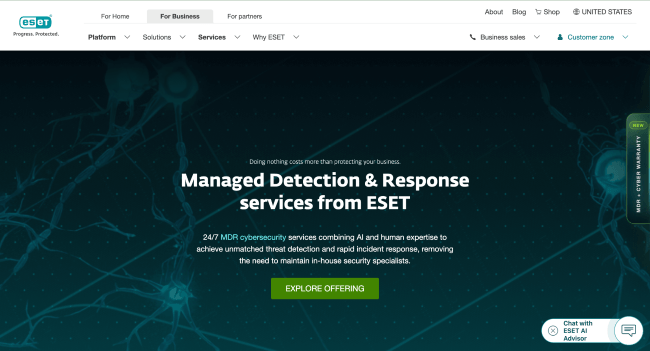
ESET sells managed detection and response through ESET PROTECT subscription tiers rather than as a separate bolt-on, pairing a 24/7 human-led service with AI-assisted security technology. The original article notes a published six-minute mean time to respond, measured from incident identification to the first action taken, and cites recognition in the KuppingerCole Leadership Compass for MDR.
The intelligence behind the service is supported by a large global sensor network and multiple research and development centers. ESET PROTECT MDR is positioned for smaller and mid-sized organizations, while ESET PROTECT MDR Ultimate adds capabilities such as retrospective and customized threat hunting, forensic incident response assistance, and a dedicated incident response lead. Enterprises evaluating the service should match those capabilities to their required response authority and internal escalation process.
2. CrowdStrike Falcon Complete
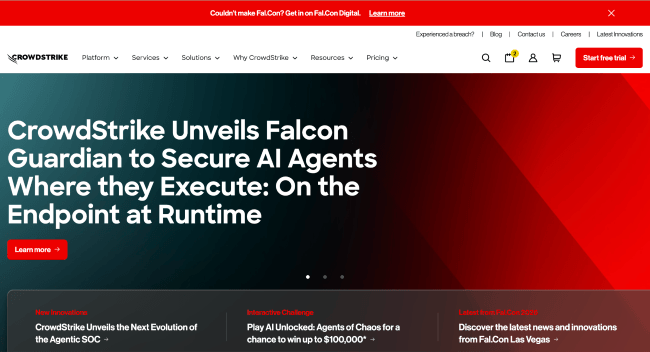
Falcon Complete delivers 24/7 detection and remediation across endpoints, identity, cloud workloads, and third-party data ingested through Falcon Next-Gen SIEM. The original comparison also notes warranty coverage of up to $2 million and recognition in an IDC MarketScape assessment of enterprise MDR and MXDR providers.
The architectural consideration is important: Falcon Complete is closely tied to the Falcon platform. That can simplify operations for an enterprise already standardized on CrowdStrike, while organizations with a mixed security estate should examine migration requirements, integration coverage, and the cost of consolidating tools before committing.
3. Arctic Wolf

Arctic Wolf pairs continuous monitoring of networks, endpoints, and cloud environments with a named Concierge Security Team rather than relying only on a rotating analyst pool. The original article states that more than 1,000 security engineers support its SOC operations.
Its commercial structure is a notable point in the comparison. Arctic Wolf does not charge on event or log volume, while endpoint agents, unlimited log retention, and external network scanning are described as included rather than separately licensed. Buyers should still confirm the exact scope in their quote, including retention terms, supported data sources, and any limits tied to endpoints or services.
4. Sophos MDR
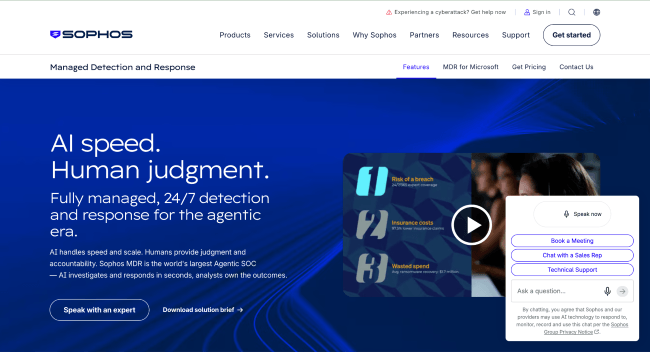
Sophos MDR supports third-party telemetry from security products and cloud services, including Microsoft, CrowdStrike, Palo Alto Networks, Fortinet, Check Point, AWS, Google, and Okta. That flexibility can matter for organizations that want managed detection without immediately replacing established controls.
The original comparison states that Sophos MDR Complete includes a Breach Protection Warranty covering up to $1 million in response expenses. Contract terms, eligibility requirements, exclusions, and the exact response scope should be reviewed directly with the provider. For broader defense-in-depth planning, see RSH Web Services' guide to essential security measures.
5. Red Canary
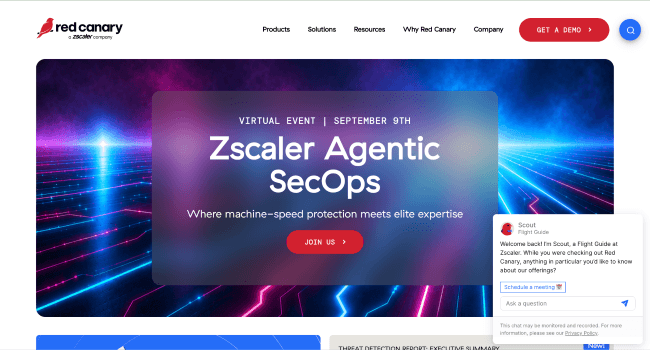
Red Canary works on top of supported endpoint tooling already in use, including CrowdStrike Falcon, SentinelOne, Microsoft Defender for Endpoint, and Carbon Black. It ingests raw telemetry rather than relying only on alerts generated by those products, giving its analysts additional behavioral context for investigations.
Coverage described in the original article spans endpoints, network, cloud, identities, and SaaS. Automated playbooks are included, and hands-on-keyboard containment is available through Active Remediation. Enterprises should verify which response actions can be pre-authorized and which still require customer approval during a live incident.
6. Expel
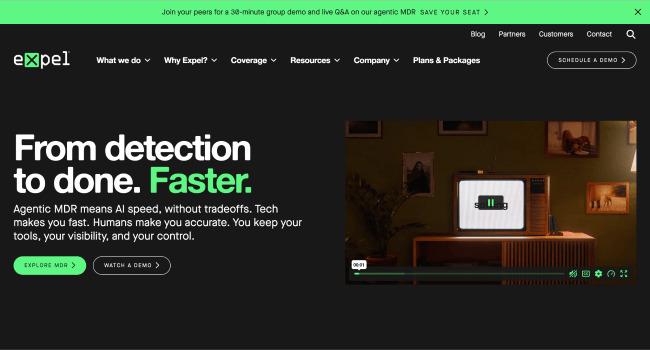
Expel is presented as a tool-agnostic service with more than 160 supported integrations and no additional Expel agent required for the MDR service. Its Workbench platform is designed to expose investigation steps, giving security teams visibility into how an alert was evaluated rather than showing only a final conclusion.
An AI triage engine filters alert volume before analysts review it. The model is most relevant to organizations that already have a reasonably mature security stack for the service to ingest. During evaluation, inventory the systems that generate meaningful telemetry and confirm that the integrations cover the products, cloud accounts, identity systems, and workflows your team actually uses.
7. eSentire
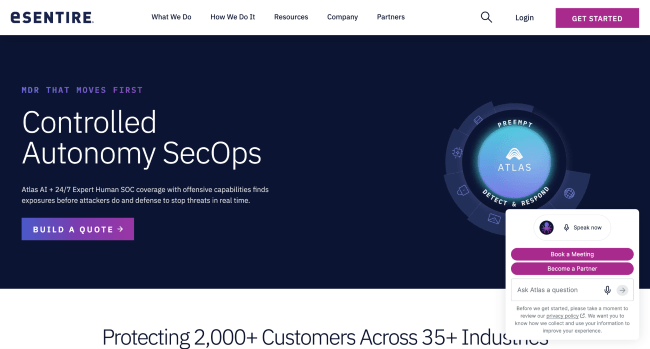
eSentire runs an open XDR platform called Atlas with more than 300 technology integrations and a 24/7 SOC. The original comparison highlights unlimited threat hunting and unlimited incident handling, a structure that can be relevant when an enterprise wants to avoid per-incident costs during periods of heavy investigation activity.
The company is described as serving more than 2,000 customers across more than 80 countries and offering Atlas Essentials, Atlas Advanced, and Atlas Complete packages. Enterprises should compare the included telemetry sources, response permissions, onboarding work, retention, and service commitments in each package rather than relying on package names alone.
8. Rapid7
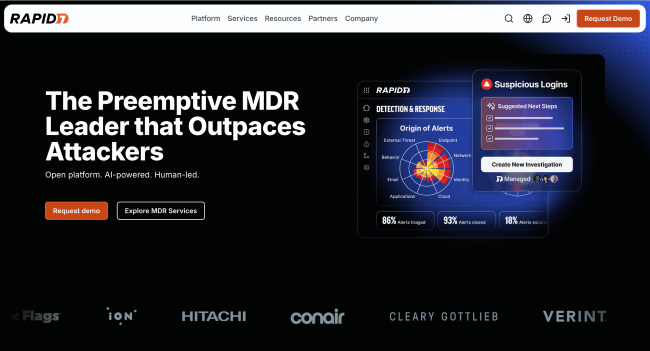
Rapid7 delivers MDR on top of its Command Platform, which also brings together exposure management, attack surface management, and next-generation SIEM capabilities. Organizations trying to connect detection work with vulnerability and exposure management may value having those functions in a shared platform.
Rapid7 also offers an MDR service for Microsoft environments, aimed at teams that have invested in Microsoft Defender and want that telemetry managed rather than replaced. Before consolidating security operations, map the existing controls you plan to retain and make sure the provider's workflow preserves the visibility your internal team needs.
9. Secureworks Taegis ManagedXDR
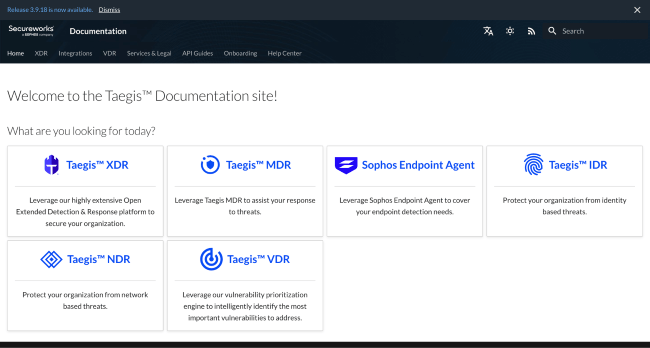
Taegis is a cloud-native detection platform backed by the Counter Threat Unit research team and extended with identity threat detection and response and next-generation SIEM capabilities. Identity visibility deserves particular attention because compromised credentials and account abuse can give attackers a path around endpoint-focused controls.
The original article also notes that Sophos completed its acquisition of Secureworks, meaning Taegis and Sophos MDR now sit under the same owner rather than operating as independent competitors. Organizations considering either service should ask how product roadmaps, support, integrations, and long-term platform plans affect a new deployment.
How Should Enterprises Compare MDR Providers?
Start with the response clause in the contract. "Detection and response" can describe anything from alert investigation and recommendations to direct isolation of endpoints and account containment. Ask whether an analyst can act overnight without waiting for approval, which actions can be pre-authorized, and how the provider handles a situation that falls outside those permissions.
Map the telemetry your organization generates against what the provider can ingest. Endpoint data alone does not describe every attack path. Identity, cloud, email, SaaS, network, and application activity can all add context. The same principle applies to website and hosting security: layered controls such as malware and phishing protection reduce the chance that one missed signal becomes a larger incident.
Ask how onboarding is staffed, what must be installed or connected, and how detection quality is validated after deployment. A polished demonstration does not show the operational work required to tune data sources, define escalation contacts, document containment authority, and remove noisy alerts. Request an onboarding plan with owners, milestones, and a clear definition of steady-state service.
Treat MDR as one security layer, not a replacement for the basics. Patching discipline, access control, staff training, strong authentication, tested recovery procedures, and network controls remain essential. RSH Web Services also provides practical guidance on creating strong passwords, website backups and recovery, and protecting websites from cyber threats.
Choosing With Your Own Constraints in Mind
There is no single MDR service that fits every enterprise. The useful shortlist is the one that matches your existing stack, regulatory obligations, geographic and data-handling requirements, staffing model, and willingness to delegate containment authority. Compare a small number of providers against the same incident scenario and ask them to explain exactly what their analysts would see, what they would do, and when your team would be contacted.
Security and compliance requirements should be part of the selection process from the beginning rather than added after the technical evaluation. The RSH Web Services guide to business cybersecurity and compliance covers related planning considerations, while the RSH Web Support section provides additional website, hosting, cPanel, SSL, and security resources.
Frequently Asked Questions
What is the difference between MDR and MSSP?
An MSSP commonly focuses on monitoring and managing security systems and may forward or escalate alerts. MDR is centered on active threat detection, investigation, and response. The practical distinction depends on the contract, so enterprises should compare the actual analyst actions, containment permissions, escalation procedures, and service levels rather than relying on the service label alone.
Do MDR services require replacing existing security tools?
Not always. The original comparison identifies Expel, Red Canary, eSentire, and Sophos as services that can ingest third-party telemetry, while CrowdStrike Falcon Complete and ESET PROTECT MDR are more closely tied to their own platforms. Integration depth still varies, so confirm support for the exact products and data sources in your environment.
How much does enterprise MDR cost?
Most enterprise MDR pricing is quote-based. Costs may be structured per device, per user, by data consumption, by service package, or through a combination of factors. Ask vendors to show how endpoint growth, log volume, cloud workloads, retention, threat hunting, incident response, and contract length affect the total cost.
Does MDR replace an in-house security team?
No. MDR can reduce the need to staff every monitoring shift internally, but the organization still needs owners for security policy, business-risk decisions, remediation coordination, access approvals, compliance obligations, and escalation. The strongest operating model clearly defines what the provider owns and what remains with the internal team.
What service levels should enterprises ask for?
Ask for written response targets, a defined escalation path, named containment permissions, coverage hours, onboarding expectations, supported telemetry sources, retention terms, reporting frequency, and clarity on where telemetry is stored. It is also worth asking how the provider measures response time and what event starts and stops that measurement so service-level claims can be compared on the same basis.
Author Bio: Betsy Trauger
A freelance web developer with a wealth of experience in utilizing RSH Web Services for her projects. With a keen eye for detail and a knack for utilizing third-party software seamlessly, Betsy's work is characterized by...
We'd love to hear your thoughts! Feel free to share your experiences or ask any questions in the comments below.
Add Comment
This policy contains information about your privacy. By posting, you are declaring that you understand this policy:
- Your name, rating, website address, town, country, state and comment will be publicly displayed if entered.
- Aside from the data entered into these form fields, other stored data about your comment will include:
- Your IP address (not displayed)
- The time/date of your submission (displayed)
- Your email address will not be shared. It is collected for only two reasons:
- Administrative purposes, should a need to contact you arise.
- To inform you of new comments, should you subscribe to receive notifications.
- A cookie may be set on your computer. This is used to remember your inputs. It will expire by itself.
This policy is subject to change at any time and without notice.
These terms and conditions contain rules about posting comments. By submitting a comment, you agree with these rules:
- Although the administrator will attempt to moderate comments, not all comments can be moderated at all times.
- You acknowledge that all comments express the opinions of the original author and not those of the administrator.
- You will not post material which is knowingly false, obscene, hateful, threatening, harassing or invasive of privacy.
- The administrator has the right to edit, move or remove any comment for any reason and without notice.
Failure to comply with these rules may result in being banned from submitting further comments.
These terms and conditions are subject to change at any time and without notice.
Tweet Share Pin Email
 What is cPanel? Complete Beginners Guide of Features
 What Is the .htaccess File? Your Complete Guide
 Importance of Maintaining Your WordPress Database
 Ultimate Guide - Best Free Image and Photo Resources
Comments