
Choosing among offshore outsourcing companies isn't simply a matter of finding the largest provider. Size can matter for a global enterprise moving a major IT operation, but it says much less about whether a company is right for a small business that needs two virtual assistants, a specialized development team, or dependable customer support.
The delivery model matters more. Some providers recruit talent that you hire and manage directly. Others supply dedicated teams, while large business process outsourcing companies take responsibility for an entire function. Understanding that difference makes it easier to compare costs, management requirements, working-hour overlap, security, and the amount of control your business keeps.
For businesses building distributed teams, it also helps to consider the security practices used outside the traditional office. RSH Web's guide to creating a safe business environment covers practical issues surrounding remote work, access, backups, and protecting company information.
Key Takeaways
- • Offshore outsourcing generally uses three delivery models: direct-hire recruiting, dedicated teams or staff augmentation, and fully managed services or BPO.
- • Direct-hire recruiters can work well for smaller teams that want to manage employees themselves rather than outsource management of the function.
- • Nearshore engineering teams in Latin America and parts of Europe can provide more working-hour overlap for North American and European clients.
- • Large global providers such as TCS, Infosys, and Accenture are structured for complex enterprise programs that can span several business functions.
- • A focused paid pilot gives a business a practical way to evaluate communication, quality, workflows, and delivery before expanding an outsourcing relationship.
What Is Offshore Outsourcing and How Do the Models Differ?
Offshore outsourcing means contracting a business function to an outside company located in another country. As the overview of offshoring explains, work subcontracted to a company abroad can involve both outsourcing and offshoring. Nearshoring follows a similar model but places the work in a geographically closer country, often improving working-hour overlap and real-time communication.
Most offshore outsourcing arrangements fall into three broad categories:
- • Direct-hire recruiting: The provider finds and vets candidates, while your business hires and manages the selected workers.
- • Dedicated teams and staff augmentation: The provider employs the specialists, but your organization directs their day-to-day priorities and work.
- • Managed services and BPO: The outsourcing provider assumes responsibility for delivering a defined business function according to agreed requirements and service levels.
The right structure depends on how much management responsibility your company wants to retain. It also changes how outsourcing is priced. A recruiter may charge a placement fee, a dedicated team may be billed continuously by role or resource, and a managed service normally operates under a broader service agreement.
Companies adding remote workers should also consider how business accounts, email, and access permissions will be managed. The business email and email security FAQ explains shared mailboxes, employee accounts, authentication, spam protection, and other considerations that become increasingly important as teams expand.
How We Chose These Offshore Outsourcing Companies
The companies in this guide represent several different outsourcing models rather than one narrow definition of an outsourcing provider. The original research reviewed company websites, public filings, and reference sources for headquarters, business history, delivery models, and current service lines.
Fast-changing figures such as quarterly revenue and employee counts aren't used as primary comparison points. Those numbers can change quickly and don't necessarily tell a prospective client whether a provider's operating model fits the work that needs to be done.
The comparison begins with a direct-hire option accessible to smaller teams, moves through nearshore engineering and customer experience providers, and then covers multinational organizations designed for larger enterprise engagements.
Offshore Outsourcing Company Comparison
| Provider | Base | Delivery Model | Best Fit |
|---|---|---|---|
| Remote Leverage | Miami, Florida | Direct-hire recruiting | Small teams hiring Latin American virtual assistants |
| BairesDev | San Francisco with Latin American talent | Nearshore engineering teams | Software projects requiring U.S. working-hour overlap |
| N-iX | Valletta, Malta | Engineering teams and managed services | Engineering, data, cloud, and related technical work |
| TaskUs | New Braunfels, Texas | Managed CX and BPO | Digital support, trust and safety, and AI data work |
| EPAM Systems | Newtown, Pennsylvania | Engineering services | Complex platform and product engineering |
| Cognizant | Teaneck, New Jersey | IT services, consulting, and BPO | Enterprises managing large IT environments |
| Infosys | Bengaluru, India | IT services, consulting, and BPM | Large modernization and AI programs |
| TCS | Mumbai, India | IT services, consulting, and BPS | Long-term, multi-function enterprise programs |
| Accenture | Dublin, Ireland | Consulting, technology, and operations | Business transformation connected with managed operations |
| TP | Paris, France | Managed CX and BPO | Multilingual customer care at global scale |
The Top 10 Offshore Outsourcing Companies
1. Remote Leverage
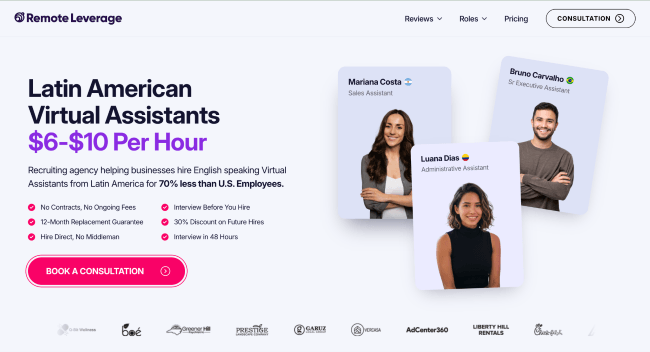
Base: Miami, Florida
Talent: Latin America
Model: Direct-hire recruiting
Remote Leverage recruits English-speaking virtual assistants from Latin America for U.S. businesses. Its model is built around recruiting rather than operating an outsourced department for the client.
Clients interview a shortlist of candidates and hire their chosen worker directly. The service uses a one-time placement fee rather than an ongoing outsourcing contract or recurring provider fee.
Available roles include administration, customer support, sales, bookkeeping, medical support, and legal work. This breadth can make the model useful for smaller organizations that need additional capacity but still want direct responsibility for assigning work and managing performance.
Worth knowing: The company advertises a replacement guarantee for placements and provides management assistance with onboarding and performance tracking. Its model also requires a minimum weekly work commitment.
Small organizations evaluating whether to expand an internal team or outsource supporting work may also find the small business technology and hosting resources useful when planning the infrastructure used by distributed staff.
2. BairesDev
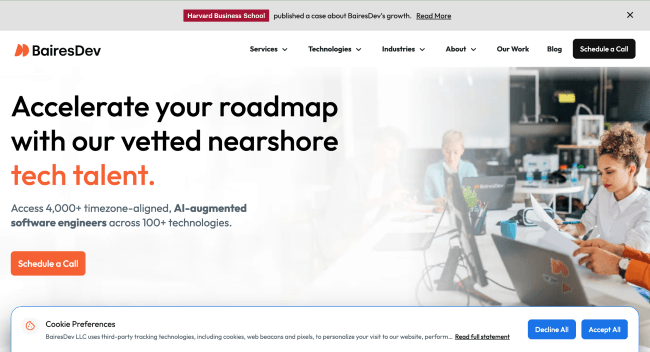
Base: San Francisco
Model: Nearshore engineering
BairesDev was established in Buenos Aires with a focus on connecting Latin American software developers with businesses that need technical talent and software development services.
Its services include staff augmentation, dedicated development teams, software outsourcing, AI transformation, quality assurance testing, and automation. The model is particularly relevant when a North American company wants engineering talent with stronger working-hour overlap than many traditional offshore locations provide.
Worth knowing: BairesDev is centered on technology and software development. Companies primarily looking for routine administrative work or customer support may be better served by a recruiting or customer experience provider.
3. N-iX
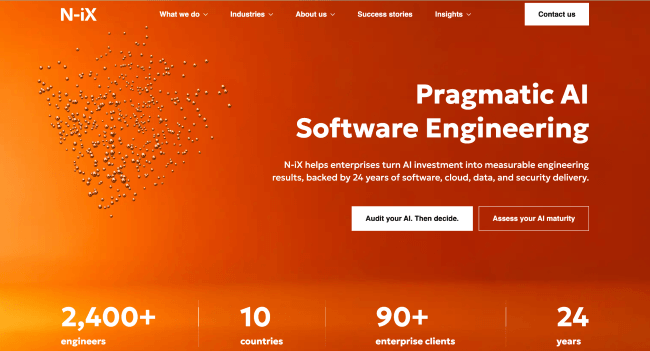
Base: Valletta, Malta
Model: Engineering teams and managed services
N-iX began as Novellix, a product startup in Lviv co-founded by Andrew Pavliv. The business later rebranded after Novell became an important client.
Its current service portfolio includes software engineering, AI consulting, cloud migration, data platform engineering, and cybersecurity. Its international delivery footprint includes operations across Europe, Latin America, and Asia.
Worth knowing: When an engineering provider operates across several countries, ask how projects can be transferred between delivery locations and how business continuity is handled if one location becomes unavailable.
That question shouldn't be limited to outsourcing companies. A broader business compliance and cybersecurity review can help organizations identify the access controls, documentation, security standards, and data-handling practices they should discuss with outside providers.
4. TaskUs
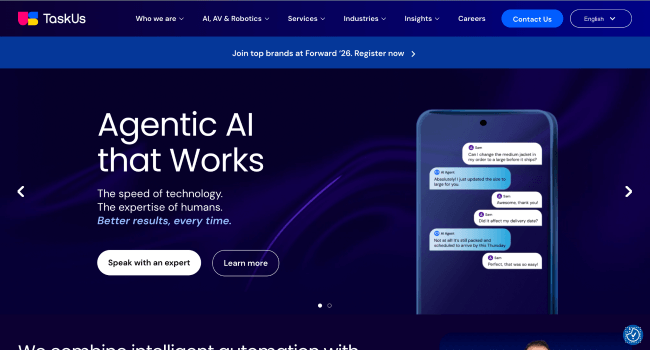
Base: New Braunfels, Texas
Model: Managed customer experience and BPO
TaskUs is a publicly traded outsourcing company focused on digital customer experience, AI services, and trust and safety operations.
Its AI-related work includes data labeling, annotation, and transcription used in machine learning workflows. Its delivery operations span multiple countries, including the Philippines, the United States, and India.
Worth knowing: TaskUs is structured for higher-volume programs. A business looking for only one or two support workers may find a direct-hire recruiter or smaller provider easier to engage.
Organizations building an online support operation can also review the practical features associated with customer support website hosting, including professional email, backups, security tools, and website management.
5. EPAM Systems
Base: Newtown, Pennsylvania
Model: Engineering services
EPAM Systems was founded by Arkadiy Dobkin and Leo Lozner and later became a publicly traded company on the New York Stock Exchange.
Its work focuses on software engineering, digital platform engineering, product development, and design. The company works with organizations ranging from startups to large multinational enterprises.
Worth knowing: EPAM's model is oriented toward complex engineering, product, and platform work. Businesses seeking routine administrative or task-based support will generally be looking at a different category of outsourcing provider.
6. Cognizant
Base: Teaneck, New Jersey
Model: IT services, consulting, and BPO
Cognizant began in Chennai as an internal technology unit of Dun & Bradstreet before expanding to serve outside clients.
The company is now a publicly traded IT services and outsourcing provider headquartered in New Jersey. Its work covers consulting, application development, IT infrastructure, and business process outsourcing.
Worth knowing: Cognizant combines extensive offshore delivery capabilities with a U.S. headquarters, a structure often used by large American organizations managing substantial technology environments.
7. Infosys
Base: Bengaluru, India
Model: IT services, consulting, and BPM
Infosys was founded in Pune by seven engineers and later established its headquarters in Bengaluru. It has grown into a major international technology consulting and outsourcing provider.
Its services include named technology platforms such as Topaz for AI, Cobalt for cloud services, and Finacle for digital banking. Business process work is delivered through Infosys BPM.
Worth knowing: Public listings in India and the United States provide prospective enterprise customers with extensive corporate reporting that can be reviewed during vendor due diligence.
8. Tata Consultancy Services (TCS)
Base: Mumbai, India
Model: IT services, consulting, and BPS
Tata Consultancy Services began as Tata Computer Systems and remains part of the Tata Group, with Tata Sons as its majority owner.
TCS provides IT services, consulting, business process services, and engineering services. Its scale and breadth place it in a different market from recruiting firms or small staff augmentation companies.
Worth knowing: The company's service model is geared toward larger organizations with well-defined requirements and potentially long-running programs covering multiple functions.
9. Accenture
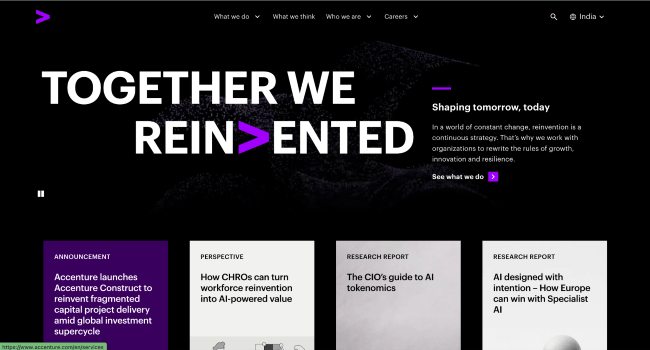
Base: Dublin, Ireland
Model: Consulting, technology, and operations
Accenture originated as Andersen Consulting before adopting the Accenture name. It operates internationally across strategy, technology, consulting, and business operations.
Its Operations business includes services such as finance and accounting, procurement, and supply chain processes. That allows a client to combine strategic consulting with technology implementation and ongoing managed operations.
Worth knowing: Accenture's model is better aligned with broad organizational transformation than hiring a single remote worker or filling a small number of individual roles.
10. TP (Teleperformance)
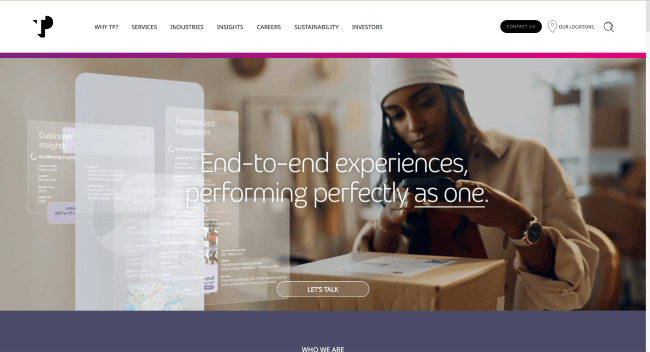
Base: Paris, France
Model: Managed customer experience and BPO
TP is the operating brand of Teleperformance SE, a multinational company founded in Paris and publicly listed on Euronext Paris.
Its services include customer care, back-office operations, debt collection, and multilingual interpreting. Its global operating model supports customer experience programs across a wide range of languages and markets.
Worth knowing: TP is designed for large-scale contact center and customer experience operations rather than businesses looking to add only a handful of agents.
How Do You Choose the Right Offshore Outsourcing Partner?
A productive outsourcing search starts with the work itself, not a list of company names. Define what needs to improve, how success will be measured, who will manage the relationship, and what information the provider will be able to access.
- • Name the function and the outcome. A specific objective such as clearing a support backlog or completing a software module narrows the field more effectively than a broad goal such as reducing expenses.
- • Match the delivery model to your management capacity. Direct hires require your organization to provide daily management. Managed services shift more delivery responsibility to the provider but require carefully defined expectations and service levels.
- • Check working-hour overlap. Development, sales, support, and other collaborative roles may benefit from shared working hours. Some back-office processes can operate effectively on an asynchronous schedule.
- • Understand who employs the worker. Recruiting, staff augmentation, and managed services create different relationships between your organization, the provider, and the people performing the work.
- • Ask about data access. Determine what systems, customer records, credentials, source code, financial information, or other sensitive resources outside workers will be able to reach.
- • Test before expanding. A limited pilot using representative work can expose communication or workflow problems before they affect a larger project.
- • Read the exit terms. Review notice requirements, replacement policies, account ownership, documentation, and how company information and knowledge will be returned when the relationship ends.
Security and Data Protection Should Be Part of Vendor Selection
Outsourcing can give people outside your physical workplace access to business systems, files, customer information, email, source code, or financial records. Security therefore needs to be evaluated as part of the outsourcing arrangement rather than added after workers have already been given access.
Ask potential providers how access is granted and revoked, whether multi-factor authentication is supported, how data is encrypted, what devices workers use, how security incidents are reported, and which recognized security or compliance frameworks apply to the service being offered.
RSH Web's guide to protecting against cyberattacks covers access controls, strong authentication, software updates, firewalls, malware protection, backups, and other safeguards that can help when reviewing your own environment before extending access to outside personnel.
Backups deserve separate attention. A contractor accidentally changing or deleting information can be just as disruptive as a deliberate attack. Maintaining recoverable copies of important systems and data provides another layer of protection. See the website backup and recovery guide for practical backup and restore considerations.
Use a Paid Pilot Before Expanding the Relationship
A sales presentation tells you what a provider intends to deliver. A pilot shows how the relationship works when real tasks, deadlines, communication, and revisions are involved.
Choose a small but representative assignment with a measurable result. Establish who will communicate with the provider, which tools will be used, what access is required, how quickly questions should be answered, and what acceptable work looks like. The pilot should be meaningful enough to reveal problems without placing a business-critical operation at unnecessary risk.
Evaluate more than the finished output. Communication quality, documentation, reliability, responsiveness, security practices, and the provider's ability to handle feedback can matter just as much once an engagement grows.
Finding an Outsourcing Model That Fits the Work
The useful question isn't which offshore outsourcing company is biggest. It's which delivery model matches the way your organization wants to operate.
A small business that wants direct control over an assistant may prefer recruiting and direct management. A company building software may need a dedicated nearshore engineering team with overlapping work hours. An enterprise moving several business processes to an outside provider may need the infrastructure, governance, and geographic reach of a global managed-services company.
Start with a defined need, understand exactly who will manage the work, review security and access requirements, and test the relationship on a manageable scope. Expand after the provider has demonstrated that its communication, quality, and operating model work for your organization.
Businesses planning the supporting website, email, security, and account infrastructure for a growing team can browse the RSH Web support resources or explore additional business, technology, security, and web hosting guides.
Frequently Asked Questions
What is the difference between offshore and nearshore outsourcing?
Offshore outsourcing places work with a provider in another country, often at a considerable geographic distance. Nearshore outsourcing uses a provider in a closer country or region, which can make working-hour overlap, meetings, and real-time collaboration easier.
Which offshore outsourcing companies suit small businesses?
Small businesses often have different requirements from enterprises signing large, multi-function contracts. Direct-hire recruiters, specialized agencies, and smaller nearshore providers may offer a better operational fit when only a few workers or a narrowly defined service is needed. The deciding factor should be the delivery model, required skills, management responsibility, security requirements, and scope of work rather than company size alone.
How do offshore outsourcing companies charge?
Pricing depends on the engagement model. Recruiters may charge a one-time placement fee. Dedicated teams and staff augmentation arrangements commonly involve ongoing charges tied to the personnel provided. Managed services are generally priced through a service agreement covering a defined function, workload, or level of service.
Is offshore outsourcing secure?
Offshore outsourcing can be operated securely, but location alone doesn't determine security. Review access controls, encryption, authentication, device policies, incident procedures, data retention, employee access, and applicable compliance requirements before providing a third party with sensitive information or system access. The same fundamentals covered in business cybersecurity and compliance planning should be considered when evaluating an outsourcing provider.
How should you start working with an offshore provider?
Begin with one clearly defined function or project and establish measurable expectations before work starts. A short paid pilot provides an opportunity to evaluate quality, communication, responsiveness, security practices, and management requirements. Scale the relationship after the provider has demonstrated that it can consistently meet the needs of the business.
Author Bio: Adam Jones
With over 10 years of experience working at major organizations and agencies. His expertise spans across...
We'd love to hear your thoughts! Feel free to share your experiences or ask any questions in the comments below.
Add Comment
This policy contains information about your privacy. By posting, you are declaring that you understand this policy:
- Your name, rating, website address, town, country, state and comment will be publicly displayed if entered.
- Aside from the data entered into these form fields, other stored data about your comment will include:
- Your IP address (not displayed)
- The time/date of your submission (displayed)
- Your email address will not be shared. It is collected for only two reasons:
- Administrative purposes, should a need to contact you arise.
- To inform you of new comments, should you subscribe to receive notifications.
- A cookie may be set on your computer. This is used to remember your inputs. It will expire by itself.
This policy is subject to change at any time and without notice.
These terms and conditions contain rules about posting comments. By submitting a comment, you agree with these rules:
- Although the administrator will attempt to moderate comments, not all comments can be moderated at all times.
- You acknowledge that all comments express the opinions of the original author and not those of the administrator.
- You will not post material which is knowingly false, obscene, hateful, threatening, harassing or invasive of privacy.
- The administrator has the right to edit, move or remove any comment for any reason and without notice.
Failure to comply with these rules may result in being banned from submitting further comments.
These terms and conditions are subject to change at any time and without notice.
Tweet Share Pin Email
 Common WordPress Mistakes To Avoid
 The WordPress Dashboard Explained
 How to Spot a Fake Email - Commonly Known As Phishing
 Best Product Review Websites - Why They are Fake
Comments