
Understanding WordPress Categories and Tags
WordPress is one of the most popular content management systems (CMS) available today, powering millions of websites worldwide. One of the essential features of WordPress is its ability to organize content effectively. This is primarily achieved through categories and tags. In this comprehensive guide, we'll explore the differences between categories and tags, their importance for SEO, and how to use them effectively in your WordPress site.
What Are WordPress Categories?
Categories are a way to group related posts together. They provide a high-level organizational structure for your blog, making it easier for readers to navigate and find content. When you create a new post in WordPress, you can assign it to one or more categories.
Key Features of Categories
Hierarchical Structure: Categories can be nested, meaning you can have subcategories. For example, a main category called "Travel" could have subcategories like "Europe," "Asia," and "North America."
- • Broad Topics: Categories typically represent broad topics. For instance, if you run a food blog, your categories might include "Recipes," "Reviews," and "Cooking Tips."
- • Navigation: Categories create a structured navigation system for your readers. Visitors can click on a category link to see all posts associated with that category, improving their experience on your site.
- • Category Slug: is the URL-friendly version of the category. It is usually all lowercase and contains only letters, numbers and hyphens.
What Are WordPress Tags?
Tags, on the other hand, are more specific keywords that describe the details of your posts. They help categorize content at a finer level and allow for more precise searches within your site.
Key Features of Tags
- • Non-Hierarchical: Unlike categories, tags are non-hierarchical. You can assign multiple tags to a single post without any parent-child relationship.
- • Specific Keywords: Tags should reflect the specifics of your post. For example, if you write a post about making chocolate chip cookies, relevant tags could include "chocolate," "cookies," "baking," and "dessert."
- • Facilitate Searching: Tags enhance the searchability of your content, making it easier for readers to find related posts based on specific interests.
Why Use Categories and Tags?
Using categories and tags effectively can significantly improve your site's organization and SEO. Here are several reasons why you should utilize both:
Improved User Experience
By categorizing your content, you make it easier for visitors to navigate your site. They can quickly find related articles without having to sift through every post. This organized structure leads to longer visit durations and lower bounce rates.
Enhance Search Engine Rankings
Search engines like Google favor well-structured content. Proper use of categories and tags can help search engines understand your site's structure, making it easier for them to index your pages. When users search for specific keywords, having relevant categories and tags can improve your visibility in search results.
Enhanced Internal Linking
Categories and tags create automatic archives for your posts. This internal linking not only helps visitors find related content but also aids in distributing link equity across your site, boosting your overall SEO.

Creating and Managing Categories in WordPress
Creating and managing categories in WordPress is a straightforward process. Here’s how to do it:
- Step 1: Access the Categories Page
- Log into your WordPress dashboard.
- Navigate to Posts > Categories.
- Step 2: Add a New Category
- In the Add New Category section, enter the category name.
- Optionally, you can add a slug (the URL-friendly version of the category name) and a description.
- Click the Add New Category button.
- Step 3: Edit or Delete Categories
- To edit or delete an existing category:
- Go to the Categories page.
- Hover over the category name and choose either Edit or Delete.
- Step 4: Assign Categories to Posts
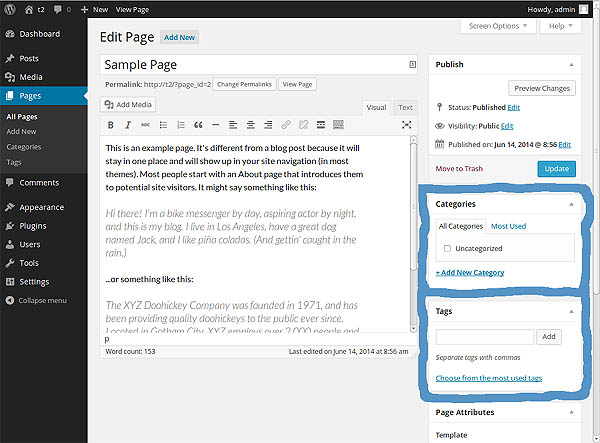
- When writing a new post or editing an existing one, look for the Categories section on the right-hand side of the post editor. Simply check the box next to the categories you want to assign or click Add New Category to create a new one on the fly.
Creating and Managing Tags in WordPress
Managing tags is similar to managing categories. Follow these steps to create and assign tags:
- Step 1: Access the Tags Page
- Log into your WordPress dashboard.
- Navigate to Posts > Tags.
- Step 2: Add a New Tag
- In the Add New Tag section, enter the tag name.
- You can also add a slug and description, but these are optional.
- Click the Add New Tag button.
- Step 3: Assign Tags to Posts
- In the post editor, you’ll find a Tags section. Enter the tags relevant to your post, separating them with commas. You can also use the Choose from the most used tags feature to select from existing tags.
Best Practices for Using Categories and Tags
Use WordPress categories and tags to create a clear, consistent content structure that helps visitors, Google, AI assistants, and answer engines understand how your posts relate to one another. A well-planned taxonomy improves website navigation, internal linking, keyword relevance, content discovery, and the overall semantic organization of your website.
- • Use categories for broad topics: Create a limited number of descriptive categories that represent the main subjects covered by your website. Most blogs should begin with approximately five to ten categories rather than creating a separate category for every post.
- • Use tags for specific details: Tags should identify narrower topics, features, tools, people, locations, or concepts discussed within a post. Use only tags that connect multiple related articles and avoid creating one-time tag archive pages with little useful content.
- • Choose clear, search-friendly names: Category and tag names should use natural phrases readers are likely to recognize or search for. Prefer specific labels such as “WordPress Security” or “SEO Plugins” instead of vague terms such as “Tips,” “Other,” or “General Information.”
- • Avoid duplicate taxonomy terms: Do not create a category and a tag with the same or nearly identical name. Overlapping archives can confuse visitors, weaken keyword targeting, and make it harder for search engines and AI systems to determine which page best represents the topic.
- • Create useful archive descriptions: Add an original introduction to important category and tag archive pages explaining what the topic covers and what readers will find there. Clear descriptions provide search engines and language models with additional context while making archive pages more useful as standalone resources.
- • Build a logical hierarchy: Use parent and child categories only when the relationship is clear. For example, “WordPress” could be a parent category with child categories for “WordPress Security,” “WordPress Plugins,” and “WordPress Tutorials.” Keep the hierarchy shallow so users and crawlers can reach important content easily.
- • Strengthen contextual internal linking: Link relevant phrases within your posts to related tutorials, category archives, and supporting resources. Learn how to create descriptive links in WordPress and review additional guidance on the proper use of WordPress categories and tags.
- • Use descriptive anchor text: Internal links should clearly identify the destination topic. Avoid generic phrases such as “click here.” Descriptive anchor text helps readers, Google, and generative AI systems understand the relationship between the current page and the linked resource.
- • Keep each post focused: Assign posts only to categories that accurately represent their primary subject. Using too many categories or unrelated tags can dilute topical relevance and make the page’s main purpose harder for search engines and answer engines to identify.
- • Format content for easy extraction: Use descriptive headings, concise definitions, short paragraphs, lists, and direct explanations. This structure helps search engines generate featured results and makes it easier for AI assistants to identify accurate, self-contained answers from the page. See how to format WordPress posts for additional guidance.
- • Maintain consistent terminology: Use the same names, capitalization, singular or plural form, and spelling whenever a category or tag appears. Consistent terminology improves semantic clarity and prevents fragmented archive pages that address the same topic under different labels.
- • Review indexing decisions carefully: Valuable archive pages with unique descriptions and several relevant posts may be useful in search results. Thin, duplicate, or rarely used archives may be better consolidated or excluded from indexing through an SEO plugin. Review available WordPress SEO plugins before changing archive indexing settings.
- • Update the taxonomy regularly: Periodically merge duplicate terms, remove unused tags, redirect deleted archive URLs when necessary, and confirm that every post belongs to an appropriate category. Regular maintenance prevents broken links, thin archives, and confusing navigation.
- • Support topical authority: Organize related articles into clearly defined subject groups and link them to comprehensive supporting pages. This helps Google and generative engines recognize the website’s expertise, relationships between articles, and coverage of a topic. Explore more RSH Web Services articles and WordPress resources.
- • Measure user and search performance: Monitor category and tag archive traffic, search impressions, engagement, and navigation behavior. Keep taxonomy pages that help users discover content, and improve or consolidate pages that receive little engagement or duplicate another archive’s purpose.
WordPress Categories and Tags Plugins
Blog Filter – Post Filters With Categories And Tags
Blog filter Plugin For WordPress blog sites with a power full filtering on posts or blogs. Blog Filter, Post Filter, Post Grid Template, Post Portfolio. By A WP Life
Bulk Edit Categories and Tags
Modern Bulk Editor for Blog Categories and Tags, create and edit hundreds of categories in a spreadsheet inside wp-admin. Quick edits. By WP Sheet Editor
Pages with category and tag
Add Categories and Tags to Pages. By YAHMAN
WP Required Taxonomies
Force users to select a taxonomy term when publishing posts. For example, make category or tags required. By VegaCorp
TaxoPress
TaxoPress enables you to manage Tags, Categories and all your WordPress taxonomy terms. By TaxoPress
Post Tags and Categories for Pages
Adds the built in WordPress categories and tags to your pages. By curtismchale
Collapsing Categories
Adds a widget which uses Javascript to dynamically expand or collapse the set of posts for each category. By Robert Felty
Categories to Tags Converter
Convert existing categories to tags or tags to categories, selectively. By wordpressdotorg
List categories
Simple plugin to display categories in any post or page with a shortcode. By Fernando Briano
Colorful Categories
New Categories widget in the awesome style! Bring colours to your categories widget make every category in its color. By Gesundheit Bewegt GmbH
WordPress Resources
Plugins WordPress.org
Unlock your site's potential with thousands of free WordPress plugins! Enhance functionality, improve performance, and add features easily. Explore, install, and elevate your website
Widgets WordPress.org
Discover WordPress widgets to customize your site’s layout easily! Add functionality and content in sidebars and footers without coding
Codex WordPress.org
Explore the WordPress Codex for comprehensive documentation and tutorials. Find guides on themes, plugins, and customization to help you master WordPress
Developers WordPress.org
Explore WordPress development with our comprehensive guides and resources. Learn to create themes, plugins, and optimize your site
Security WordPress.org
Discover WordPress Security best practices to protect your site. Learn about updates, secure hosting, and essential plugins to keep your content safe from threats
Themes WordPress.org
Browse thousands of free WordPress themes to customize your site’s look. Find the perfect design for your blog, business, or portfolio, and enhance your site’s functionality
Online Courses WordPress.org
Explore free WordPress courses designed for all skill levels! Learn about themes, plugins, and site management through structured lessons to boost your skills and create stunning websites
Community WordPress.org
Join the WordPress community! Collaborate with passionate contributors, share ideas, and help shape the future of WordPress. Get involved in events, discussions, and projects today
WordPress Resources RSHWeb.com
RSH Web Services complete WordPress resources. Our blog helps you find WordPress Resources like optimize your site, improve performance, and master all things WordPress
 Frequently Asked Questions
Can I change a WordPress category into a tag later?
Yes. WordPress includes a Categories and Tags Converter that can change selected categories into tags or tags into categories. Before converting terms, create a complete WordPress backup and review which posts use each term. Conversion may affect archive URLs, menus, breadcrumbs, internal links, and visitor navigation.
What happens when I delete a WordPress category?
Deleting a category does not delete the posts assigned to it. Posts that have no remaining category are usually moved to the default category configured under Settings. The deleted category archive may return a 404 error, so update menus and internal links and create a redirect when the old archive received traffic or backlinks.
Should category and tag archive pages be included in Google search results?
Useful archive pages can remain indexable when they contain several relevant posts, a clear description, and meaningful navigation. Thin, duplicated, or rarely used archives may be better excluded from indexing. A reputable WordPress SEO plugin can help control archive titles, descriptions, canonical settings, and indexing preferences.
How do I fix posts that appear under “Uncategorized”?
Edit each affected post and assign it to an appropriate category, then update the default post category under Settings > Writing. WordPress requires posts to have a category, so a default is automatically applied when none is selected. Choosing a meaningful default category prevents new content from appearing in the generic “Uncategorized” archive.
Do WordPress pages support categories and tags?
WordPress categories and tags are built primarily for posts and are not normally available for pages. A plugin can add taxonomy features to pages, but this is not necessary for most websites. Pages are usually organized through parent-child relationships, menus, and contextual links. Review these WordPress category plugins before extending taxonomy features.
Can changing a category slug break existing links?
Yes. Changing a category slug changes the archive page URL and may cause old bookmarks, menu items, backlinks, or internal links to return a 404 error. Add a permanent redirect from the old URL to the new one and update links throughout your website. See how to add and edit WordPress links.
Do I need a plugin to manage WordPress categories and tags?
No. WordPress includes built-in tools for creating, editing, deleting, and assigning categories and tags. Plugins become useful when you need bulk editing, advanced filtering, automatic term suggestions, taxonomy management, or categories for pages. Start with the standard features, follow established category and tag practices, and add a plugin only when it solves a specific need.
Summary
Understanding the difference between WordPress categories and tags is crucial for anyone looking to create a well-organized and user-friendly blog. By utilizing these tools effectively, you can enhance your site’s navigation, improve your SEO, and create a better experience for your readers.
Remember, the key to success is not just creating categories and tags, but doing so thoughtfully and consistently. With the tips and strategies outlined in this guide, you'll be well on your way to mastering the art of content organization in WordPress. Happy blogging!
Also see: Using WordPress To Build A Website
Installation with cPanel and Softaculous. WordPress Themes. Changing Themes. Plugins, Creating New Pages. Appearance, Step by step guide, more
Overwhelmed With WordPress?
If WordPress is a bit much try our new AI Website builder and Website Importer
Author Bio: Mira Calden
A WordPress wizard with over eighteen years of experience designing, optimizing, and troubleshooting sites on the world’s favorite CMS WordPress....
Related WordPress Tutorials and How To Guides
Tweet Share Pin Email